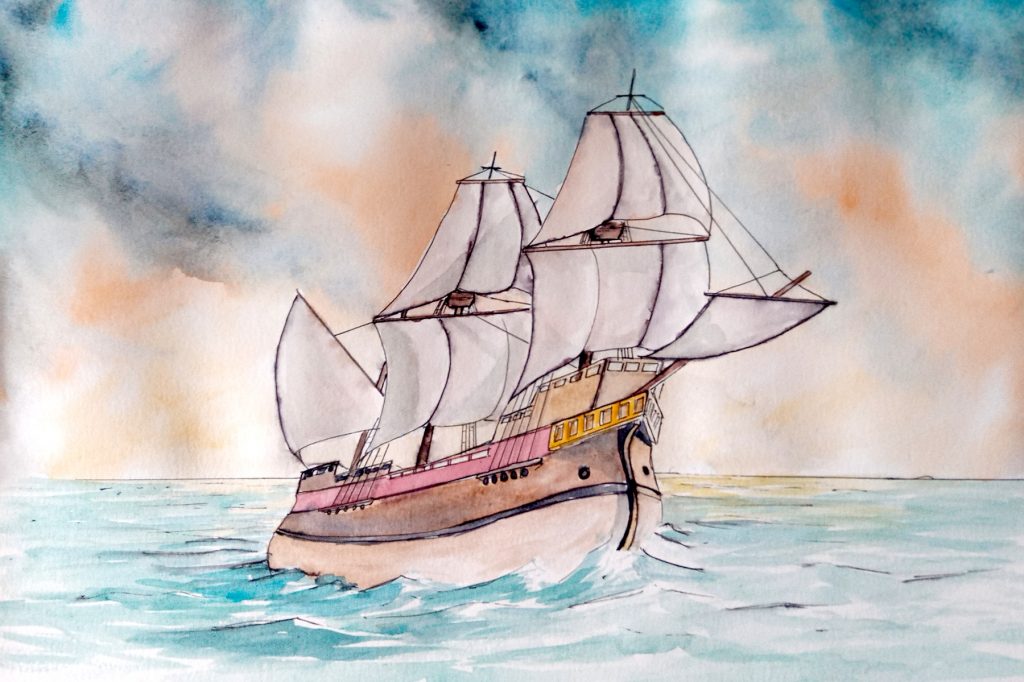
The following excerpt is from the book Blessed: The 400 Year
Legacy of the Pilgrims by Teresa L. Ong.
Chapter Two
“Makarios” – Blessedness
As we revisit the incredible story of the Pilgrims as it unfolded from Scrooby to Plymouth Plantation, we will encounter injustice, imprisonment, confiscation of worldly goods, loss of livelihood, separation by relocation and by death, poverty, privation, disease, and many other circumstances that sane people try to avoid. The Pilgrims could not avoid such sufferings; they did not even try to do so. They rejected the “impoverished values” of modern society, identified by Francis Schaeffer as, “personal peace and affluence.”1
Unlike the rich fool in Jesus’ parable, they were not seeking to lay up stores on earth for their personal ease. (Luke 12:15-21) Unlike him, they were willing to give up everything in order to be “rich toward God.” (Luke 12:21) We often consider ourselves to be most blessed when personal peace and affluence are at a maximum. How can we then say that the Pilgrims were “a blessed people” when they had minimal amounts of those commodities? We may begin to understand by looking at how they saw themselves.
They did not see themselves as some great “movement,” deserving worldly acclaim or entitling them to human support. They were merely a desperate, ragtag group of believers in search of unmolested worship of God. When Abraham left his fatherland to follow God, he had the promise that God would make him a great nation and a blessing to all the nations of the world. (Gen. 12:1-3) The Pilgrims did not have such an assurance, but it did not matter. They did not seek to be a great nation because they already viewed themselves as part of the great spiritual offspring of Abraham through faith. (Gal. 3:7) They, in their generation, would carry on his pilgrim journey to the spiritual promised land.
The Scrooby congregation did not call themselves “pilgrims” or “pilgrim fathers.” From an earthly standpoint, they always and only thought of themselves as English Christians. They were sad to leave England for Holland, but they worked hard to maintain their English identity during the twelve or so years they were there. They were offered an opportunity to go directly from Holland to America and establish a Dutch colony, but they chose not to do so.2 A deciding factor for them in moving on was that their children were losing their English identity as they grew up, married, established businesses, and served in the Dutch military.3
More important to them, their children were also losing their spiritual identity and fervor in the midst of the secularized and permissive Dutch culture. When this began to happen, the Scrooby church knew it was time to pull up stakes. They appealed, however, to their earthly homeland, England, to allow them to establish a proper plantation in the New World.4
Though they did not call themselves “pilgrims,” William Bradford saw their situation as analogous to that of the “pilgrims” listed in Hebrews 11. The Greek word translated “pilgrim, ” used only three times in the New Testament, means “stranger” or “exile,” in other words, someone who is outside his familiar homeland. This word aptly described the experience of the Scrooby church. They had gone out of their homeland as exiles to Holland, and they would venture on further to be strangers in the New World. But that was only one more stop on the journey to the “city whose builder and maker is God.” (Heb. 11:10) When they were preparing to leave Holland for England en route to America, Bradford wrote: “…they knew they were pilgrims, and lifted up their eyes to the heavens, their dearest country, and quieted their spirits.”5
Rev. Thomas Prince, one of the early chronicler’s of the Plymouth colony, called the Pilgrims God’s “vine brought out of Egypt… for its planting in the wilderness.”6 Through this metaphor we might begin to understand their blessedness. The Greek word in the New Testament translated “blessed” is “makarios.” Embedded in that word is the idea of enlarging or elongating something (“mak” as in “macro”).7 When vines are planted in good soil with abundant water and nutrients, they grow; they are enlarged. Hot house plants do not always make a good transition, even when put in good soil. Seedlings must be hardened to stand up to fluctuations of temperature, moisture, wind, and sun. The Pilgrims were not just a vine to be transplanted, they were a Providentially hardened vine that would be able to weather all conditions and thus be enlarged.
The greatest exposition on blessedness is in Christ’s “Sermon on the Mount” in Matthew 5. As Stalker describes it, here Christ gives us “the entire octave of its music.”8 He points out that the “Beatitudes” do not merely describe the character of a true Christian. If that were true, “Blessed are they that mourn,” would be as absurd as the statement “Happy are the unhappy.” Instead, “Each of them is an equation, on the one side of which stands ‘blessed,’ while on the other there are two qualities– the one a character or condition, and the other a gift to be given to those who are found in this condition.”9
In the following chapters we will look at the character of the Pilgrims and their various conditions during their struggle for freedom of conscience before God. And we will look at the particular and precious gifts given to them by our Savior. We will see how the transplanted vine was enlarged and bore the fruit of the True Vine– the visible evidence of the character of Jesus. (John 15:1-11)
- Francis Schaeffer, How Should We Then Live? (Wheaton, Illinois: Crossway Books, 1996
printing) p. 205. - Daniel Wilson, The Pilgrim Fathers. (London: Thomas Nelson, 1850) p. 353.
- William Bradford, The Plymouth Settlement. [ed. by Harold Paget, 1909] (San Antonio,
Texas: Mantle Ministries, 1988) [reprint of the original with modern standard spelling] p. 21. - Ibid., p. 25.
- Ibid., p. 49.
- Prince quoted in Cheever, p. 127.
- W.E. Vine, Vine’s Expository Dictionary of New Testament Words.(STBC, n.d.), p. 133.
- Stalker, p. 31.
- Ibid., p. 32.